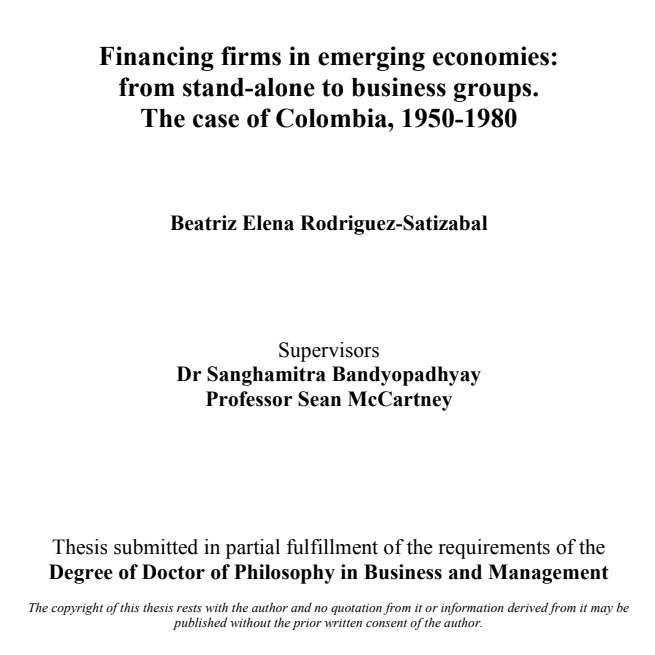
Financing firms in developing economies: from stand-alone to business groups. The case of Colombia, 1950-1980.
Rodríguez-Satizábal, Beatriz (2021). Thesis for PhD in Business and Management. United Kingdom: Queen Mary University of London.
Abstract
Content
What accounts for the consolidation and persistence of business groups in emerging countries during the second half of the twentieth century? This thesis measures and explains the (relative) performance of group-affiliated firms and financial institutions during Colombia’s modernisation period by applying various economic methods to new historical and financial evidence. After identifying the characteristics of the Colombian economic and business development after a period of deglobalisation under the Import Substitution Industrialisation (ISI) model between 1950 and 1980, the thesis asks: (1) What are the characteristics of the Colombian business groups and how did they evolve between 1950 and 1985? How did the characteristics change after a period of deglobalisation? (2) What was the relationship between the sources of capital and the creation of internal markets in business groups? (3) What is the role of business groups in the development of Colombia’s stock markets? Using a combination of economic theory, quantitative financial analysis and qualitative business histories, this thesis finds that: (1) business groups proliferated in the second half of the twentieth century, especially in the period between 1950 and 1980 when they became a strong ownership network (2) growing stand-alone firms in emerging countries serving in traditional industries were more willing, despite being more able, to create internal markets for resources and capital by creating an hybrid organisational structure instead of the so-called ‘Chandlerian large corporation’; and (3) those financial institutions that were founded during the period, which changed the liability limitations, helped groups to enjoyed more diversified portfolios and a greater access to the small capital market, which was colonised by the groups. It contributes by adding to the growing literature on business groups around the world and the literature on financial development in Latin America Finally, the thesis proposes a typology for future data collection on business groups across Latin America and challenges the argument on the decline of the business groups as a result of development.
Keywords: Business groups, business history, agglomeration, financial development, Latin America, Colombia, emerging.
JEL classification: D21, D22, L22, L25, N86, O12, O16
Acknowledgments
To love in doctoral times
‘Si te niegas a hacer una gran locura, jamás tendrás un buen recuerdo’
This is the sentence I can see now posted on the wall while trying to gather some inspiration to write these words of gratitude. Yes, it was madness. The journey was unexpectedly timeless and extremely challenging in every aspect. However, here I am at the end of the road, ready to say thank you.
Be ware readers! This is the only section where academic writing is nowhere to be seen. This doctoral journey has been encouraged by incredible people and institutions. Therefore, it is only fair that on top of learning about Colombian business groups, you also discover my supporters.
Be ware guardians! My mum always tells me that love – for people, dreams, and pursuits – is the force that makes you move the world. My dad insists there are no unbreakable barriers when you know where you are heading. Although someone once told me that it is very difficult to talk about love in a language that is not your mother tongue, the intention here is to break the barrier. Every single word is filled with love and the hope that you will always be part of my journey.
Thank you…
Carlos Dávila, my mentor and ‘academic dad’, for inspiring me to create links between economics and business history from the moment I stepped into his course as an undergraduate. After welcoming me to the Business, History and Entrepreneurship Research Group (GHE), your generous guidance through the crafts of writing, researching, and teaching was the main reason behind my becoming an academic and insisting on it. I am a proud member of the ‘Escuela Dávila’. Our long conversations across the years have taught me the patterns of business history in Latin America, the importance of being accurate, the responsibilities to the new generations when teaching, the need for consistency in speech, despite the risk of repeating myself, and the magnitude of ‘academic entrepreneurship’.
Sanghamitra Bandyopadhyay for having me as your teaching associate long before being my thesis supervisor, and then becoming a mentor and a friend who guided me through the doctoral experience and academic life in the UK. Your advice exposed me to incredible opportunities: the awareness of the growing theory and empirics of inequality, poverty, and mobility, the invitation to become an active member of the Centre for Globalisation Research (CGR), the realization that a Ph.D. is a very enjoyable journey to knowledge, and the challenge to explore other regions, methods and topics.
Sean McCartney for encouraging the publication of my writing under the assumption that research needs to be shown. Luis Fernando Molina, a colleague and friend, for constantly inspiring me with research and teaching ideas, because ‘we still have many questions to answer, classes to teach and archives to explore’. Your unstoppable pipeline of books and papers is a wonderful example for an early career researcher. Caterina Gennaioli for inviting me to play a key role in CGR. Under your leadership, I found a wonderful place to put my non-academic skills to use, and your openness was vital during my activities at the Centre. Paloma Fernández-Pérez for always encouraging me to find my voice in academic writing. The feedback on my work and the conversations about business history topics and being a woman in academia challenged my future self in a wonderfully positive way. Bernardo Bátiz-Lazo for inviting me to his academic initiatives, especially those focusing on the use of technology to promote business history research around the globe. Roxana Gutiérrez-Romero, Androniki Triantafylli, and Thomas Kemeny for making me a part of their teaching teams; it was a pleasure to teach in the UK by your side. Gerben Bakker and Alejandra Irigoin for opening a door to understand the academic persona beyond the Latin American context.
For the fellowship shown across the years as the cement of the academic community, as well as the advice and generous feedback: Ann Carlos, Andrea Lluch, Andrew Perchard, Aurora Gómez Galvarriato, Araceli Almaraz, Ben Wubs, Candelaria Saiz, Christopher Miller, Erica Salvaj, Fco. Javier Fernández, Francisco Azuero, Gabriela Recio, José María Ortíz-Villajos, Gustavo del Angel, Kenda Mutongi, Javier Serrano, Javier Vidal, José Galindo, Luis Enrique Orozco, Marcelo Bucheli, Marco Palacios, Manuel Llorca Jaña, María Inés Barbero, Martha Garavito, Martha Prevezer, Martín Monsalve, Niall MacKenzie, Neil Rollings, Norma Lanciotti, Panos Panagiotopoulos, Patrick Fridenson, Phil Scranton, Suki Sian, and Takafumi Kurosawa.
Beatriz Eugenia Satizábal Villegas (MiMa) and Hernán Rodriguez Pizarro (MiPa) for being my life givers and providers of all the tools for the resilience needed in this journey, your kind insistence on chasing my dreams took me to the UK and brought me to this point of completion. You kept the dream alive. You kept me going: ¡siempre me ayudaron a ver lo posible! Simón Andrés Rodriguez Satizábal (hermanito) for calling me to order when needed, your advice has been always right on the spot. I have true admiration for your honesty, integrity, empathy, and positive influence. Beatriz Villegas de Satizábal (abuelita) for believing in my career path and always spoiling me with little treats. Andrés Satizábal Villegas (tio) and María Claudia Satizábal Villegas (tiita) for understanding the ups and downs when listening to my random calls. Your different ways to look at the world are always a good puzzle to solve. Eduardo Satizábal Amaya (primito) for the late-night texts full of care.
José Luis Quintana-Goyeneche for holding my hands and always being an amazing force. Cecilia Lanata-Briones a friend who is always there for me, no questions asked. A colleague who is continually seeking ways to triumph together, your friendship has given me more than anyone can expect in both academia and life. Juliana Montoya, Tatiana Pérez, Maria Antonieta Cueva, Amrita Manohar,Rana Aljaibachi, Natasha Sardarizadeh, Daniel de Castro and Mohammed Kasbar for trusting me, making me a part of your extended family, opening your hearts to listen to my adventures and giving me the chance to reason with your challenging questions. Joe Francis for taking the time to highlight issues and provide perspectives. Verónica Durana for the encouraging words, always right on time. Natali Ortiz and Gloria Inés Perea for being the A-team for funding conundrums. Evita Priestley, Thomas Priestley and Olivia Dean for letting me be part of your little worlds.
On La Isla, or from a distance, you were always a source of good vibes, exciting long conversations or unexpected assistance: Abdullah Ijaz, Aida Calvo, Alvaro Martínez, Alejandro Quiñones, Alexander Cats, Andrés Posada, Camilo Martín, Carlos Brando, Carlos Calle, Carlos Suárez, Catalina Lopera, Catalina Muñeton, Catalina Porras, Clelia Imperiali, Cristina Soto, Daiga Liepina-Matharu, Daniel Moyano, Danula Gamage, David Schnarch, Edwin López, Emilio Lastra-Gil, Eran Padumadasa, Fabian Florez, Gabrielle Cocomelo, Garrick Hileman, Germán García, Howard Dean, Ian Priestley, Ivan Sangiorgi,Jaime Guzmán, Jairo Campuzano Hoyos, Juan Ignacio Geymonat, Juliana Martínez, Julian Naranjo, Juan Luis Martirén, Julio Zuluaga, Karen Torres, Kazuo Kobayashi, Laura Milanés, Lina Lozano, Lina Martínez, Lisa Schopol, Manuel Bautista, María Angélica Martínez, María Isabel García, Mariano Manta, María José Fuentes, María Fernanda Quintero, Molly Fife, Murat Ozdogancik, Nilumi Amarabandu, Nevine Ismael, Oscar Palma, Piedad Salgado, Pilar Pardo, Rocio Granados, Sebastian Álvarez, Sergio Castellanos, Sonia Camacho, Soo Jung Oh, Virgilio Ramón, and Zsofia Erdos.
Finally, the institutions supporting my doctoral studies, whose involvement, from financial support to participation in academic events, was key to the completion of this thesis: School of Business and Management at the Queen Mary University of London, the Facultad de Administración at the Universidad de los Andes, Colciencias, Colfuturo, the European Business History Association, the Association of Business Historians, the Business History Conference, the University of Tubingen and the Centre for Business History in Scotland at the University of Glasgow, the Universitat de Barcelona, the University of York, IUESAL at the Universidad de Alicante, the Unversidad Pablo de Olavide, the Universidad de la República, the Colombian Society at UCL, CLADHE, the Asociación Colombiana de Historia Económica, and NEP-His.
¡MILLONES DE GRACIAS! Just keep smiling and dancing. London and Bogotá, July 2020
The Viva was an incredible closure for the PhD journey as it challenged me to present the research in a setting were being a colleague was a synonimous of curiosity. The virtuality was well managed by Panos Panagiotopoulos, who kindly accepted to be the chair. As always, he was my open door to use the virtuality in favour of the difusion of research. Teresa da Silva Lopes and Brigitte Granville thanks for a delightful session of questions, suggestions, and more questions. Thank you both for taking the time to read the thesis in detail, your comments were very helpful to improve the final document. Special thanks to Teresa for being always a guide into the world of business history and a box full of sweet surprises. Bogotá, December 2020
 Beatriz Rodríguez Satizábal